
Unlocking insights through multidisciplinary research
Tampere University (TAU), Finland, is one of the key partners in the UPRISE project, bringing expertise in data science, systems biology, and multidisciplinary research to help better understand how environmental exposures affect health from the earliest stages of life.
As one of Finland’s most multidisciplinary universities, TAU brings together research and education across technology, health, and society. With over 22,000 students and a diverse international community, the university is known for its collaborative approach and its focus on solving global challenges such as sustainability, climate change, and human well-being.
Within UPRISE, this multidisciplinary mindset plays a central role.
Making sense of complex biological data
One of TAU’s main contributions to UPRISE lies in analysing the large and complex datasets generated throughout the project.
Through the Finnish Hub for Development and Validation of Integrated Approaches (FHAIVE), TAU leads the processing and integration of multi-omics data — including epigenomic and transcriptomic information — to better understand how exposure to ultrafine particles (UFPs) and micro- and nanoplastics (MNPs) may affect fetal development.
This work allows researchers to identify patterns of molecular changes that may occur both in the short and long term, and to link these changes to potential health outcomes.
As the TAU team explains:
“The massive volume of omics data collected in UPRISE presents an unprecedented opportunity to uncover the molecular changes linked to exposure to ultrafine particles and micro- and nanoplastics during pregnancy.”
From data to meaningful insights
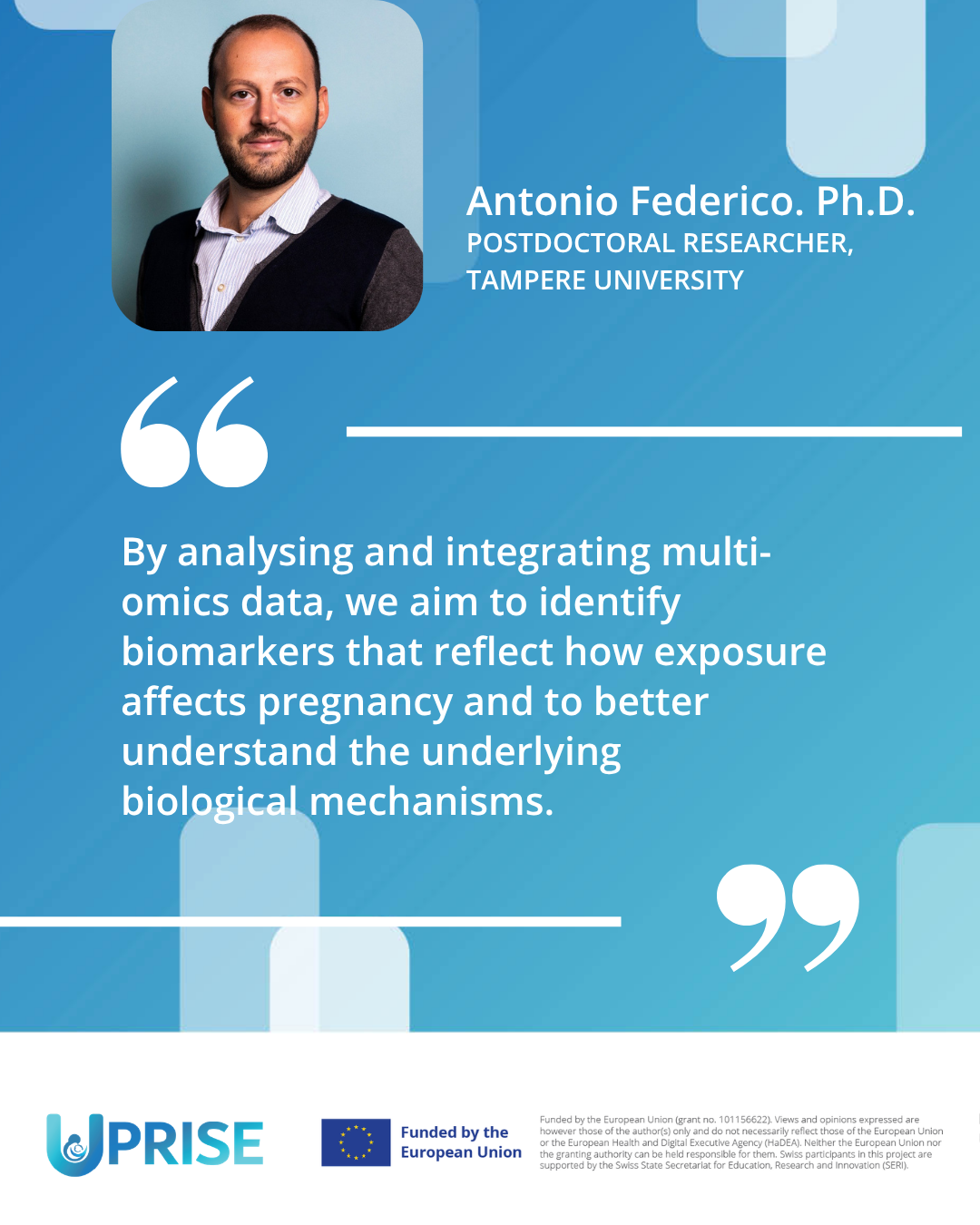
Using advanced systems biology approaches, TAU integrates different layers of biological information to identify biomarkers — measurable indicators that can signal early changes in health.
These biomarkers can help researchers better understand how environmental exposures influence pregnancy and may contribute to outcomes such as preterm birth.
Beyond identifying patterns, TAU also contributes to in silico modelling approaches, such as Adverse Outcome Pathways (AOPs). These models help map how exposure to pollutants may lead to specific biological effects and health outcomes, supporting a more complete understanding of cause-and-effect relationships.
Bridging disciplines to protect health
A key strength of TAU’s work is its ability to connect different scientific fields.
By linking environmental monitoring data with clinical and molecular research, the team helps bridge the gap between exposure science, epidemiology, and toxicology — an essential step for building robust, evidence-based knowledge.
“This research is a truly multidisciplinary effort. By connecting environmental monitoring, clinical research, and molecular biology, we help generate the evidence needed to define safe exposure levels and protect the most vulnerable stages of life.”
Supporting better policies for future generations
Ultimately, TAU’s contribution goes beyond scientific discovery. By identifying biomarkers and clarifying how pollutants affect biological systems, their work supports the development of evidence-based policies and health guidelines.
This is particularly important when it comes to protecting pregnant women and unborn children, among the most vulnerable to environmental risks.
Through collaboration within UPRISE, Tampere University helps transform complex data into meaningful insights — bringing us one step closer to safer environments and healthier futures.