
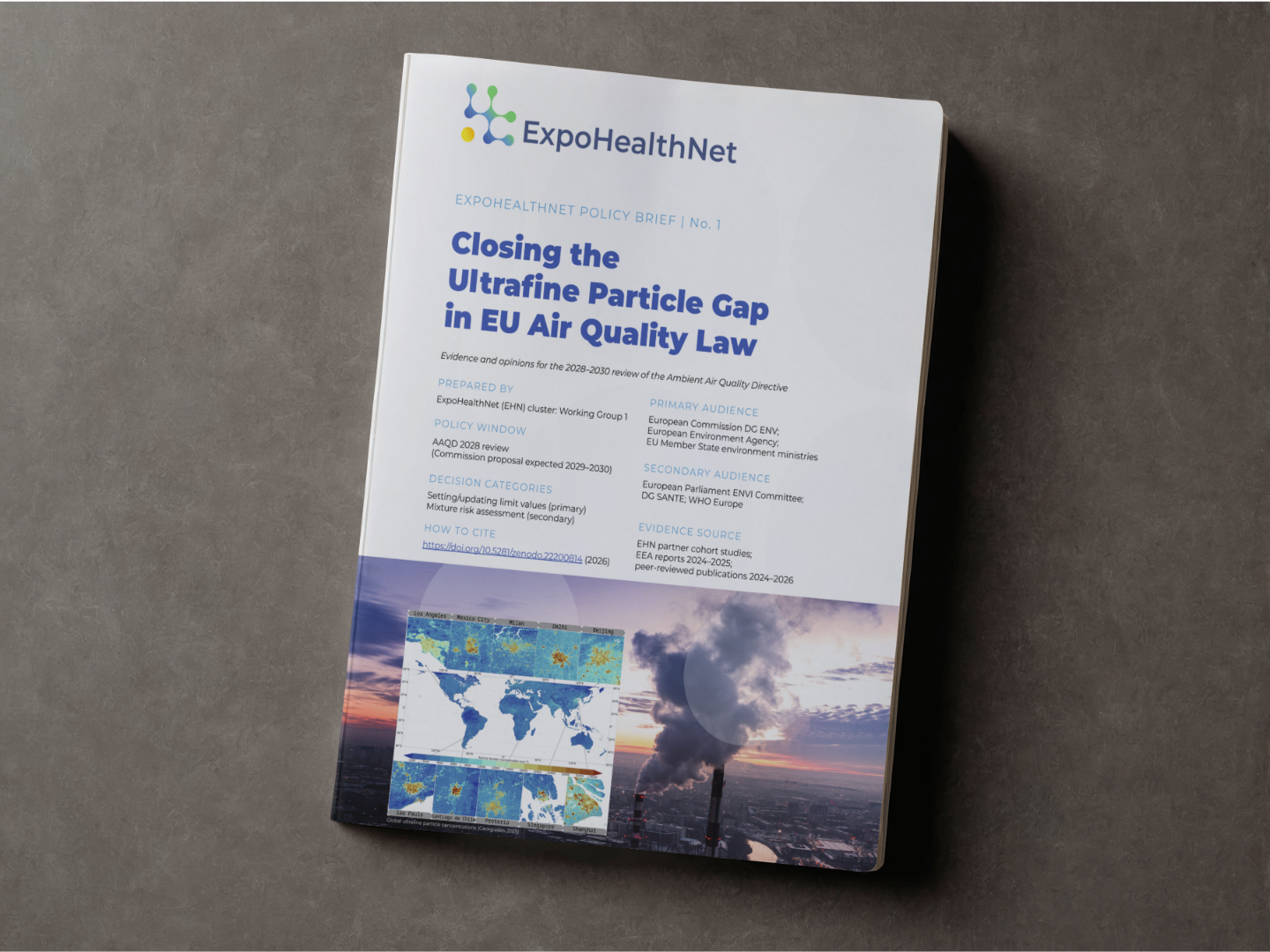
ExpoHealthNet has published its first Joint Policy Brief, “Closing the Ultrafine Particle Gap in EU Air Quality Law”, authored by Working Group 1 (WG1). The document presents the cluster’s first joint policy brief, establishing an evidence-based roadmap to address ultrafine particles (UFPs) within the European Union’s evolving air quality regulatory framework.
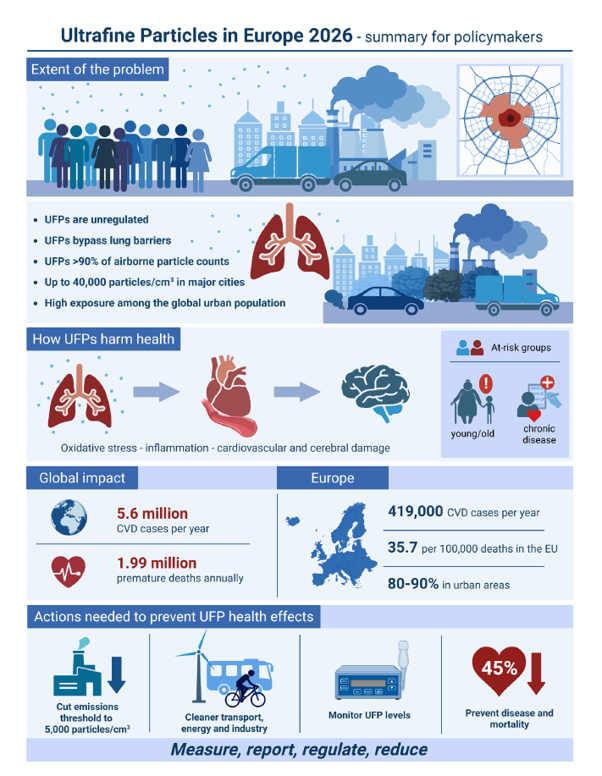
The Hidden Threat: 419,000 New Cardiovascular Cases Annually
Air pollution remains Europe’s largest environmental health risk. While European regulations set strict limits for larger particulate matter like PM2.5 and PM10 ultrafine particles remain unregulated. However, these are the smallest and potentially most harmful fraction of airborne pollution.
New scientific research published by ExpoHealthNet Cluster partners in 2025 and 2026 provides stark evidence of the health burden caused by UFPs alone:
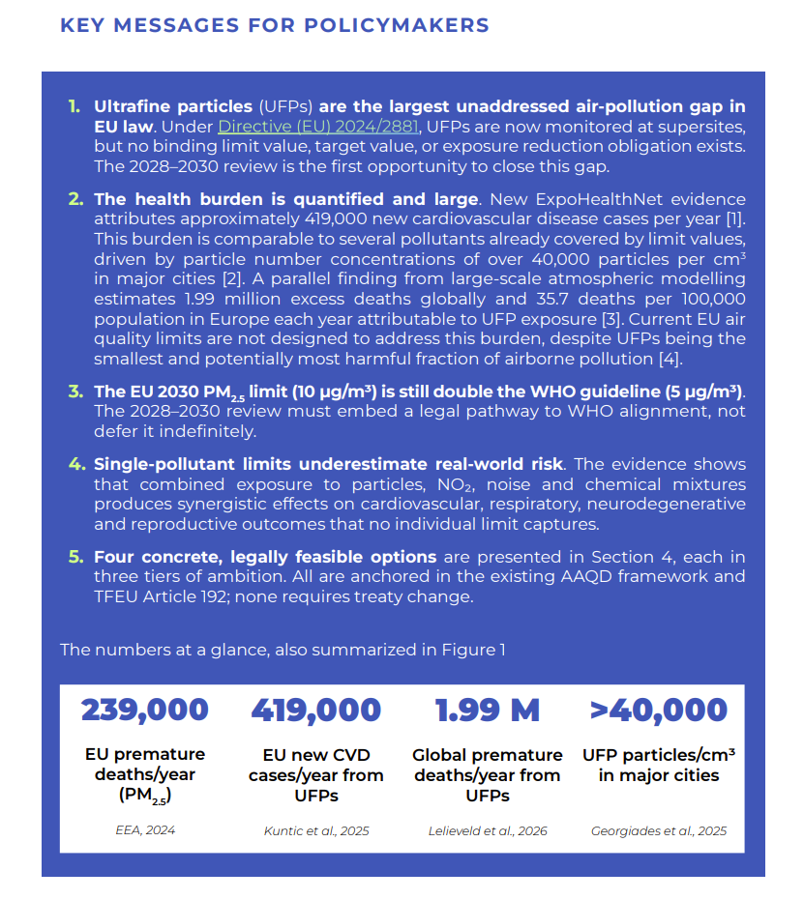
- 419,000 new cases of cardiovascular disease (CVD) per year in the EU attributable directly to UFP exposure.
- 35.7 deaths per 100,000 people per year in Europe (based on evidence currently under peer review at Cardiovascular Research).
Strategic Window: Aligning Science with EU AAQD Milestones
The policy brief targets Article 3 of the newly adopted Ambient Air Quality Directive (AAQD, Directive (EU) 2024/2881). Article 3 requires the European Commission to review the scientific evidence underpinning air quality standards by 31 December 2030, every five years thereafter, or earlier if substantial new scientific findings emerge. The recent ExpoHealthNet findings represent the exact type of scientific progress Article 3 was designed to integrate.
To ensure the 2030 review has sufficient, high-quality data to evaluate UFP standards, crucial groundwork must be laid across upcoming regulatory milestones:
- 11 December 2026: Deadline for EU Member States to transpose Directive (EU) 2024/2881 into national law. This launches a new monitoring regime, including mandatory UFP measurements at designated monitoring supersites.
- 31 December 2028: Under Article 19, Member States at risk of missing 2030 limit or target values must establish comprehensive air quality roadmaps.
- 31 December 2030: The Commission’s formal scientific review under Article 3.
The decisions taken between 2026 and 2028 on measurement protocols, reporting standards, and environmental modelling will directly determine the evidence base available to EU decision-makers during the 2030 review.
Actionable Pathways for Key EU Stakeholders
The policy brief provides practical recommendations tailored directly to four core institutions:
- European Commission (DG ENV)
- European Environment Agency (EEA)
- EU Member State Environment Ministries
- European Parliament ENVI Committee
Core Recommendations
The brief outlines four policy options, each structured across three tiers of ambition (baseline, moderate, and high ambition). Every option is legally grounded within the existing AAQD framework and Article 192 Treaty on the Functioning of the European Union (TFEU), ensuring that immediate policy progress can be achieved without requiring EU Treaty amendments.
- Option 1: Monitoring & Standardisation
Harmonise measurement methodologies and expand supersite coverage during transposition (2026). - Option 2: Data Integration & Modelling
Ensure robust UFP exposure reporting and spatial modelling ahead of the 2028 roadmap deadlines. - Option 3: Target Setting
Define evidence-based target and threshold values for UFPs within national air quality roadmaps. - Option 4: Standards Review Preparation
Formalise criteria for incorporating new UFP health risk data into the Article 3 (2030) review.
A Replicable Science-to-Policy Approach
Beyond its immediate focus on UFPs, the policy brief documents Working Group 1’s science-to-policy translation methodology. By detailing how research outputs were translated into structured policy options, this document establishes a standard framework that will be used for all subsequent joint policy briefs produced across the ExpoHealthNet cluster.